cumin seeds plant Nigella (Black Cumin Seed) – UJAMAA SEEDS
SKU: 11628050703
cumin seeds plant

cumin seeds plant Nigella (Black Cumin Seed) – UJAMAA SEEDS

Sale price$25.16 Regular price$27.95
Save 10%

Pay in installments of $6.99 with ShopPay, AfterPay and Klarna

Shipping Estimate
USA
  • USA
  • CAN

Ships within 48 hours · Estimated delivery Jul 3 - Jul 8

Promo Codes Available:

For Your Every Summer RSVP, with Code: SUMMER15

Description

cumin seeds plant Nigella (Black Cumin Seed) – UJAMAA SEEDSNigella sativa Seeds per pack ~ 100 Germination: 85% Oct 2025 Packed for 2026 Origins and History Nigella sativa, commonly known as black cumin, black seed, or simply nigella, is native to Southwest Asia and parts of the Middle East. This ancient plant has been cultivated for thousands of years and is highly regarded in traditional medicine systems such as Ayurveda, Unani, and Islamic herbal practices. Seeds of Nigella sativa were even found in the

Nigella sativa  

Seeds per pack ~ 100 

Germination: 85% Oct 2025 Packed for 2026

Origins and History 

Nigella sativa, commonly known as black cumin, black seed, or simply nigella, is native to Southwest Asia and parts of the Middle East. This ancient plant has been cultivated for thousands of years and is highly regarded in traditional medicine systems such as Ayurveda, Unani, and Islamic herbal practices. Seeds of Nigella sativa were even found in the tomb of the Egyptian Pharaoh Tutankhamun, highlighting its long-standing cultural and medicinal value.

Easy to grow and exquisitely delicious, the soft & fern-like foliage extraordinary flowers of black cumin are short, often under 2 feet, thriving in gardens as well as raised beds and containers, even with partial sun. Each gorgeous seedhead is borne on a long, strong stem perfect for cutting and, as the seeds mature, we love to shake the seeds on top of our plates with dramatic flourish.

Appearance and Characteristics:
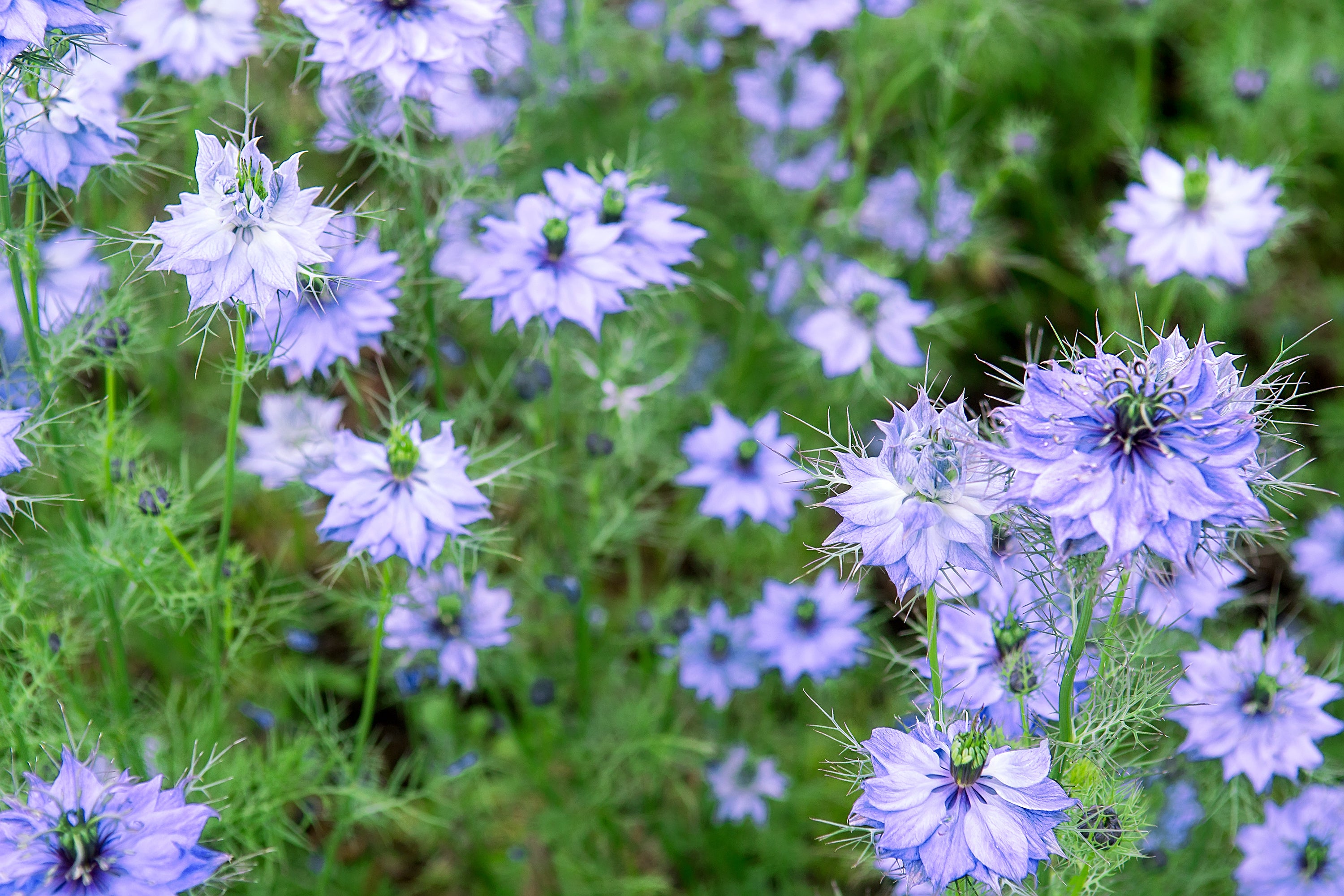
Nigella is an annual flowering plant that typically grows 12–18 inches tall. It has finely divided, feathery foliage and produces delicate, pale blue to white flowers with five to ten petals. After flowering, it forms inflated seed capsules filled with small, angular, matte-black seeds. The seeds have a slightly rough texture and emit a distinctive aroma when crushed, often described as earthy, peppery, and slightly nutty with hints of oregano and onion.

Culinary Uses:
Nigella seeds are used as a spice in various cuisines, especially Indian, Middle Eastern, and North African. They are often added to breads like naan, sprinkled on flatbreads, or used in pickles, curries, and spice blends such as Panch Phoron (a Bengali five-spice mix). The seeds impart a warm, slightly bitter flavor with a subtle crunch and are often used whole. Despite being called "black cumin," they are not related to true cumin (Cuminum cyminum), though they share some flavor similarities.

Black Cumin seeds are a Mid-East as well as Indian delicacy, where they are known as kalonji. Distinctly different from brown cumin with their own characteristic flavor reminiscent of toasted onion flake, black pepper plus oregano, black cumin is commonly toasted for curries, bread and steamed rice. We often toss 20 seeds or so in a pot of rice and savor the exquisite flavor and heavenly aroma it imparts!

Growing Tips:
Nigella thrives in full sun and well-drained soil. It prefers cooler seasons and can be direct-sown outdoors after the last frost. Sow the seeds shallowly (1/8–1/4 inch deep), as they need light to germinate. Space plants about 6 inches apart. Nigella does not transplant well, so direct sowing is ideal. It requires minimal maintenance once established, and it can self-seed if left undisturbed. Regular watering is necessary until the plants are established, but overwatering should be avoided.

Harvesting Guidance:
Harvest nigella seeds when the seed pods turn brown and begin to dry on the plant. Cut the seed heads and place them upside down in a paper bag to finish drying. Once fully dry, crush the pods to release the seeds and winnow away the chaff. Store the seeds in an airtight container in a cool, dry place. Properly stored, they retain flavor and potency for up to a year. Seeds harvested from healthy plants can also be saved for planting the following season.

Shipping Notes
  • Free Standard Shipping on $100+ Orders to the USA.
  • Except Preorder products are shipped in 48 hours.
  • Delivery to the USA:
  1. Standard Shipping : 3-10 business days
  • If time is of the essence, please consider selecting expedited delivery for faster service.
Exchange/Return Notes
  • We offer a 30-day return/exchange service after receiving.
  • Final sale items are not eligible for returns or exchanges.
  • To process your return/exchange, please contact us at [email protected]
  • Please click here for more details>>> Return & Exchange Policy
SKU: 11628050703

Discover Niche Categories That Outsell cumin seeds plant

Top-Converting Item to Boost Your Average Order

4.7 ★★★★★
Based on 1938 reviews
Sort
Highest Rating
Newest First
Oldest First
Product Reviews
A
Verified Purchase
Anthony Gagliardi
Pawtucket, US
★★★★★ 5
Good book
Format: Paperback
Good book
WAS THIS REVIEW HELPFUL?YesReportShare
Reviewed in the United States on July 28, 2021
T
Verified Purchase
tyrone
Pawtucket, US
★★★★★ 5
Bought it for me and a friend
Format: Paperback
Excellent Book ! A must read ! TYRONE C .
WAS THIS REVIEW HELPFUL?YesReportShare
Reviewed in the United States on June 15, 2019
C
Verified Purchase
CJ
Draper, US
★★★★★ 4
Buy it
Format: Paperback
Just finished reading it. It’s a good, easy read.
WAS THIS REVIEW HELPFUL?YesReportShare
Reviewed in the United States on June 8, 2019
M
Verified Purchase
MW
Fort Morgan, US
★★★★★ 5
Quality Book
Format: Paperback
Quality book.
WAS THIS REVIEW HELPFUL?YesReportShare
Reviewed in the United States on December 14, 2019
M
Verified Purchase
Michael Burnam-fink
Waukegan, US
★★★★★ 5
There is a war... for your Mind!
Format: Kindle
"There is a war... for your Mind!" That's the slogan of InfoWars, the incendiary conspiracy news network and nutritional supplement marketing firm. And while Alex Jones is wrong about almost everything, he's right about that. In LikeWar Singer and Brooking ably synthesize a sophisticated picture of information warfare in 2018, drawing from sources as diverse as Taylor Swift, Donald Trump, and ISIS, to argue that the internet has lead to a blurring of lines between consumer, citizen, journalist, activist, and warrior which threatens the foundations of liberal democracy. The tech companies which built these platforms and profited from them must grapple with the politics of their technologies, before we all reap the whirlwind. Computer networks and smart phones connect billions of people, allowing ideas to flow faster than ever before in history. Sometimes, the results can be impressive. The Chiapas Zapatista movement in 1994 was a dial-up and fax version of a network insurgency that managed to bring enough international opprobrium on Mexico that the government blinked, and reached some kind of political accord (Chiapas is complicated). More recently, Eliot Higgins and a team of open source analysts at Bellingcat managed to track down the exact BUK missile system and Russian soldiers responsible for shooting down MH 17 in 2014. But there are a lot of dark sides. When people connect, the emotion that spreads most rapidly is anger. Lies spread five times faster than truth. Musicians can use social networks to directly connect with their fans, and ISIS uses it to connect with alienated Muslim youths worldwide. Social networks sort diverse citizens into filter bubbles of people who think alike. Eliot Higgin's careful open source intelligence has a paranoid fun-house mirror version in the QAnon conspiracy, where Qultist decoders find hidden messages from an alleged 'senior white house source'. And then there is the matter of information war, an area that even now, after years of offensive cyber operations, liberal democracies still don't understand. Hostile propaganda slips into Western news networks and major platforms like Twitter, Facebook, and Instagram are infested with bots. LikeWar can even take a personal toll. Over the course of writing this book, General Michael Flynn went from forward looking full-spectrum commander to head Trumpist conspiracy cheerleader to indicted and plead out felon. Flynn's fall is complex, but it can't be separated from the internet. If the trolls got him, what chance does your idiot cousin stand? The counters, 'citizen truth teams' and senior emissaries to groups vulnerable to recruitment, seem like thin reeds against the coming maelstrom of noise. LikeWar starts with Clausewitz's dictum that war is a continuation of politics by other means, and there are clear links between cyberspace and physical space. Intensity of hashtags impacted the subsequent intensity of Israeli airstrikes during attacks on the Gaza strip. ISIS used propaganda to create an aura of invincibility that outflanked the defenders of Mosul, while Russia denied that its 'little green men' were even in Ukraine. But the difference is that cyberspace is constructed space rather than natural space. The networks are built, maintained, and owned by real corporations and real people. The internet grew from an anarchic specialized scientific network to a major engine of commerce and communicate with little deliberate government oversight. Section 230 absolved American companies of responsibility for policing content, with major carve outs for copyrighted IP and pornography. Yet as concerns over cyberbullying and counter-terrorism rose, major networks adopted digital constitutions that were permissive towards speech and censorious towards erotica. Policing content is and was possible, but always took a back seat to growth and engagement, the guide stars of Silicon Valley. The future is if anything, darker. Advances in machine learning and AI allow ever more realistic bots, computer generated DeepFakes where a politician can be programmed to say anything, and personalized targeting of people with exactly the propaganda they'll believe. There are defensive counters, but if I might draw military analogies, what we saw in 2016 was armored warfare circa 1918: clearly the future, but not yet a mature system. Given the pace of technology, we only have a few years before digital blitzkrieg. I'm extremely online, and I've been following this space for years. I've presented at multiple conferences on this topic, including Governance of Emerging Technologies and Association of Internet Researchers. LikeWar is the book I wish I'd written. Cognizant, forward looking, and deeply researched, it is vital reading for anyone interested in technology or politics. My only reservation is that I wish the sources were better linked in the text, instead of being buried in static endnotes. Maybe the next edition will push an update.
WAS THIS REVIEW HELPFUL?YesReportShare
Reviewed in the United States on October 19, 2018

recommand products