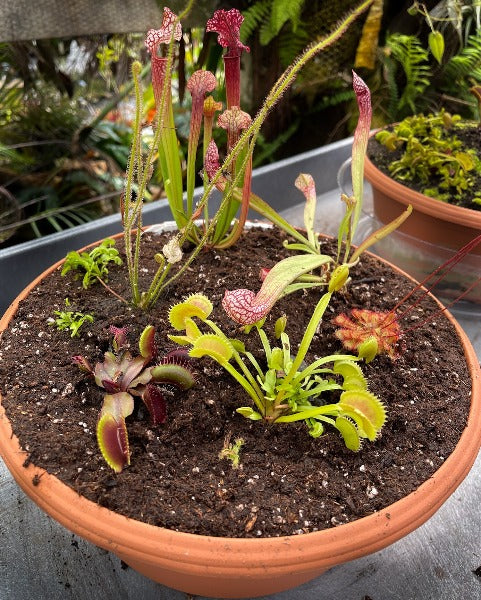
indoor pitcher plant for sale 6 Plant Deluxe Beginner’s Bog Kit
SKU: 36239727987
indoor pitcher plant for sale

indoor pitcher plant for sale 6 Plant Deluxe Beginner’s Bog Kit

Sale price$20.55 Regular price$22.83
Save 10%

Pay in installments of $5.71 with ShopPay, AfterPay and Klarna

Shipping Estimate
USA
  • USA
  • CAN

Ships within 48 hours · Estimated delivery Jul 3 - Jul 8

Promo Codes Available:

For Your Every Summer RSVP, with Code: SUMMER15

Description

indoor pitcher plant for sale 6 Plant Deluxe Beginner’s Bog KitThis is a great kit to make your very own container planting of a few different kinds of temperate carnivorous plants. These plants will enjoy being grown outdoors, in many areas and will catch tons of flies, yellow jackets, and gnats. Our kit is great if you are new to carnivorous plants, want a showpiece for your garden, or just want to get planty! And, we will ship this kit for free! If you order this kit in the summer, its best to place it in full

This is a great kit to make your very own container planting of a few different kinds of temperate carnivorous plants. These plants will enjoy being grown outdoors, in many areas and will catch tons of flies, yellow jackets, and gnats. Our kit is great if you are new to carnivorous plants, want a showpiece for your garden, or just want to get planty! And, we will ship this kit for free!

If you order this kit in the summer, it’s best to place it in full morning sun outside, where it will be protected from the afternoon sun a bit, just to reduce the shock to the plants. By the next year, they’ll be fully acclimated and will not need as much protection.

We send you a 12 x 5 inch terracotta plastic pot, XX-large water saucer, two bags of peat and perlite mix (premixed), a little long-fibered moss to the cover holes on the bottom of the pot, and a selection of temperate plants. The plants we send vary by month depending on what we have available but in general, you will receive a mix of:

Venus flytraps (Dionaea), American Pitcher Plants (Sarracenia), and temperate sundews (Drosera)

We send an assortment of plants depending on the season and what looks the best! We send you plants either potted or in plugs based on availability. We cannot customize these collections.

Daniela will walk you through building your own bog and care instructions in this video:


Care Instructions:

Growth Habit: Venus flytraps are low-growing bog plants native to North and South Carolina. These plants grow their traps, modified leaves, from a rhizome that spreads over time. The traps will die back frequently all year, have high leaf turnover, and many new traps will grow throughout the spring and summer. In spring, the traps grow, often low to the ground and small. In summer, they grow their best traps, taller and more prominent. As Fall comes on, the traps start to die back, growing lower to the ground and smaller, and by winter, the plant will be dormant, with many or all of the traps gone, but the rhizome remains healthy and intact throughout winter dormancy even if you cannot see any traps growing.

Sarracenia will grow tall modified leaves, pitchers, that vary greatly in size and shape by the hybrid or species of Sarracenia. Each plant grows many pitchers from the rhizome in the soil over the spring, summer and fall. These are temperate plants like Venus flytraps, growing actively in the warm sunny months of the year and dying back to the rhizome in winter. 

Drosera are found all over the world in many different forms, they have sticky leaves that catch small flying bugs. They have high leaf turnover, dying back frequently but growing lots of new leaves. Many of the temperate Drosera sent in this kit will die back to a hibernaculum in the soil in winter.

Sun: Full sun. These plants require lots of direct sun to grow and produce leaves. In many areas, they can be grown outdoors in full sun. If you live in a very hot AND very dry place like Arizona or Sacramento, for example, you will want to grow your plants in full morning sun with protection from the afternoon sun or under 30% shade cloth. It is common for several leaves to "burn" and die back when you first place your plant into the sun; your plant is acclimating to your conditions, and in most cases, new leaves will soon grow and fully acclimated. Thead can be grown indoors and on extremely sunny windowsills that receive all-day sun, but they will require a grow light in most circumstances due to the amount of light the plant needs. Grow lights should be 6-12” from the light depending on the light and a 10-12 hour day. These plants generally are not a good candidate for a terrarium as they need intense light and good airflow. Grow outdoors if possible for best results.

Water: Always keep them in a saucer with a few inches of distilled, rainwater, or reverse osmosis water. Never let them dry out, especially in the hot summer months. These are bog plants that prefer water-logged conditions unless you live somewhere both very hot AND extremely humid, like Alabama. In that case, let the water tray dry out for a day or two between refills. Always use distilled, reverse osmosis, or rainwater only. These plants are especially sensitive to their water quality, and giving them mineral and salt-free water is very important. In winter, when the plants are dormant, you can let them dry out a bit between rain storms, but do not let the soil get so dry that it pulls away from the edges of the pots. Be sure to supplement water as needed in between rains in winter.

Temperature and Dormancy: These are warm-temperate plants, meaning they need warm summers and chilly winters. They should be grown outdoors year-round in areas with mild winters. They thrive in temperatures ranging from 20 degrees - 90F degrees and can take a brief freeze or high-temperature spike up to 105F degrees for a short period. If nighttime temps drop below 20 but rise again during the day above 40, your plant will be fine outside.

If you live in an area with very cold winters, where nighttime temperatures drop below 20 degrees for sustained periods, you have three options for providing them with winter dormancy: the garage method, mulching in, or the fridge method. Dormancy is triggered by a combination of exposure to shorter photo-periods and cooler temperatures in the 40-60's F. While you can skip a dormancy period once or twice, in the long term, your plant will begin to do poorly and will eventually die if you skip this crucial period.

The garage method: Bring your plant indoors to a sunny windowsill in an unheated room or garage, where the nighttime temperatures will dip down to 50-60F. Keep it well watered during this period, do not let it dry out, and put it outside again when the outside nighttime temperatures increase consistently above 20F.

The mulch method: Mulch them very, very well outdoors. Pack at least four inches of mulch on top of the plants and all around the sides to prevent winds from chilling them and freezing the roots. You can also dig the pots into the ground and then mulch heavily on top.

The fridge method: remove the plants from pots, gently clean the roots of soil, wrap the roots in a bit of damp long-fibered New Zealand sphagnum moss, place the plants in a resealable bag, and put the bag into the refrigerator. Leave them in the fridge from October to February, periodically checking on them to ensure they are still moist and not growing mold or fungus. Pot them back up in February. You can vary the timing to align with your outside nighttime temperatures so that your plants can come out of dormancy when it is safe to place them back outside. You can leave them in the fridge for an extended period if you have very long winters.

Soil and Repotting: We prefer a mix of four-part fertilizer-free peat moss to one-part perlite. You can add our pre-made mix to your order here. Repot, dividing out plants and refreshing the peat and perlite, every 3 years in January or winter. 

Feeding and Fertilizer: These plants will catch plenty of food when grown outdoors. When grown indoors, they will significantly benefit from fertilizing, a foliar fertilizer, and feeding the traps. Plants grown outdoors will appreciate a foliar feed as well. Apply MaxSea fertilizer once per month to the foliage only. Dilute 1/4 teaspoon of MaxSea into one gallon of water and then apply to the leaves with a mister bottle. If you would like to feed the traps of your flytrap, it is recommended that you use live prey, as the traps usually require continued movement from their food to stimulate the complete absorption process. They will often open too soon if fed inert foods and do not absorb nutrients. We recommend live mealworms, which are available from any pet store. After digestion, Venus flytraps open back up, leaving the exoskeleton of their prey. They have liquified and absorbed the contents of the insect, but the exoskeleton remains. This does not need to be removed. Traps often die back after a big meal; new ones will grow, and the plant benefits greatly from the nutrients!

More Information: For further information on dormancy, repotting, dividing, and more, check out our website, or our YouTube channel.

Shipping Notes
  • Free Standard Shipping on $100+ Orders to the USA.
  • Except Preorder products are shipped in 48 hours.
  • Delivery to the USA:
  1. Standard Shipping : 3-10 business days
  • If time is of the essence, please consider selecting expedited delivery for faster service.
Exchange/Return Notes
  • We offer a 30-day return/exchange service after receiving.
  • Final sale items are not eligible for returns or exchanges.
  • To process your return/exchange, please contact us at [email protected]
  • Please click here for more details>>> Return & Exchange Policy
SKU: 36239727987

Discover Niche Categories That Outsell indoor pitcher plant for sale

Top-Converting Item to Boost Your Average Order

4.7 ★★★★★
Based on 1674 reviews
Sort
Highest Rating
Newest First
Oldest First
Product Reviews
A
Verified Purchase
Amy Biggs
Whiting, US
★★★★★ 5
Revolutionary Health Guide That Actually Transforms Daily Wellness Through Practical Science!
Format: Hardcover
Glucose Revolution has been absolutely transformative for my health understanding and provides exactly the actionable, science-based approach needed to optimize energy, weight, and overall wellness through blood sugar management that actually works in real life! As someone who struggled with energy crashes, weight fluctuations, and general wellness concerns while wanting evidence-based solutions rather than fad diet approaches, this book delivers the comprehensive education and practical strategies that make sustainable health improvement achievable through understanding glucose impact on daily functioning. The scientific foundation is outstanding with clear explanations of how blood sugar affects energy, mood, weight, and long-term health while making complex metabolic concepts accessible to readers without medical backgrounds. The research-based approach provides confidence that recommendations are grounded in genuine science rather than marketing trends or unsubstantiated claims. What impressed me most is the practical application focus that translates scientific knowledge into daily habits and food choices that actually work within busy lifestyles and real-world eating situations. The actionable strategies eliminate the gap between health knowledge and implementation that makes many health books intellectually interesting but practically useless. The meal timing and food combination guidance provides specific, implementable advice about optimizing glucose response through strategic eating patterns that don't require extreme dietary restrictions or complicated meal planning. The flexible approach accommodates various dietary preferences while delivering consistent metabolic benefits. The energy stabilization benefits have been genuinely life-changing with elimination of afternoon crashes and dramatic improvement in sustained energy throughout the day that supports productivity and overall quality of life. The consistent energy demonstrates real metabolic improvement rather than temporary dietary effects. The weight management insights explain the connection between glucose spikes and weight gain while providing sustainable approaches to weight control that don't rely on calorie restriction or unsustainable eating patterns. The metabolic approach to weight management proves more effective than traditional dieting methods. The food selection strategies help identify which foods support stable blood sugar while showing how to modify meals and snacks to minimize glucose spikes without eliminating entire food groups or following restrictive eating plans that become impractical for long-term adherence. The lifestyle integration makes glucose optimization practical within normal social eating, dining out, and family meal situations where extreme dietary approaches become socially isolating or practically impossible to maintain consistently over time. The educational value extends beyond glucose management to comprehensive understanding of nutrition science and metabolic health that supports informed food choices and health decisions across various wellness goals and life circumstances that require adaptable health knowledge. The motivation enhancement comes from visible, measurable results that demonstrate the effectiveness of glucose management approaches while providing sustainable motivation for continued healthy choices that don't rely on willpower or temporary enthusiasm that fades over time. The long-term health impact addresses chronic disease prevention through metabolic optimization while providing proactive health strategies that support aging well and maintaining vitality throughout life rather than reactive approaches that address problems after they develop. The accessibility makes advanced nutritional science understandable and applicable for readers regardless of previous health education while providing depth sufficient for those wanting comprehensive understanding of glucose metabolism and its health implications. The value for transformative health improvement is exceptional for a book that provides education and strategies equivalent to expensive nutritional counseling while delivering lasting knowledge that supports lifelong wellness enhancement through practical, sustainable approaches. For individuals seeking evidence-based health improvement that addresses energy, weight, and overall wellness through practical strategies that work within real-life circumstances while providing genuine understanding of metabolic health, this book delivers exactly the scientific foundation and actionable guidance needed for sustainable health transformation without extreme measures or temporary solutions.
WAS THIS REVIEW HELPFUL?YesReportShare
Reviewed in the United States on November 29, 2025
M
Verified Purchase
Marcus@TauCeti
Lexington, US
★★★★★ 5
Let me very clear. This book saved my Life!
Format: Hardcover
After a surprise diagnosis of Diabetes right before my retirement, this is the first book a bought after seeing segments on YouTube with the science of eating. I lost 60 pounds, got my glucose under control in less than 3 months and threw away all my diabetes medication! After three months, My doctor came in shaking my hand with congratulations! I was blown away. The book is full of practical advice for what to eat, when to eat, and what order to eat parts of your meal to control your blood glucose and not succumb to Diabetes. Life is all about choices! This book has easy instructions, thorough explanations, a little tongue in cheek humor along the way. If you want to kick your downward health spiral and kick diabetes to the curb making good health choices, then this is the Book for you.
WAS THIS REVIEW HELPFUL?YesReportShare
Reviewed in the United States on March 4, 2026
K
Verified Purchase
K.A.K.
San Leandro, US
★★★★★ 4
Worth reading to better understand blood sugar, but don’t limit yourself to this one resource
Format: Hardcover
My mother had type 2 diabetes and ultimately died from related kidney failure. For years I have exercised and managed my diet in an effort to avoid a similar fate. I was therefore stunned during a recent doctor's appointment when it was revealed that my hemoglobin A1c was above normal limits. I immediately ordered a continous glucose monitor and was dismayed to see that my blood glucose levels were regularly exceeding what would be considered normal. I am now trying to learn as much as possible about preventing these elevated glucose levels. In my research I was led to Jessie Inchauspe (Glucose Goddess on Instagram) and decided to buy her book, The Glucose Revolution. I will say that the majority of the information in this book is available for free on her Instagram account. However, I like the simplicity of reading through the book rather than scrolling through posts and reels. The author gives a thorough overview of glucose, explaining the different forms and how they act in our bodies. She explains glucose spikes and has a really good explanation of what the hemoglobin A1c test is measuring. She then shares 10 hacks to help lower your blood sugar levels that I feel are relatively easy to incorporate into your eating plan. Some of them, like eating dessert over a sweet snack (eat a sweet food after a meal rather than on its own) were things that I have already been doing intuitively. I do wonder at the description of our stomachs as a sink and the intestine as the pipe below. She claims that when we eat carbs first, they flow uninterrupted into the intestine. Drawing on information from my college nutrition classes many years ago, I seem to remember that chemical digestion begins in your mouth and that because of the churning in your stomach, the food that you eat will all be mixed around and therefore it doesn't really matter what order you eat your foods in. That being said, it's a relatively minor thing to eat a veggie starter and/or eat foods in the described order. I also question the idea that our blood sugar shouldn't rise more than 30 points after eating. If my blood sugar is at 80, that means after eating my glucose level should not be above 110. That is well below the generally accepted rise to 140. I'm not saying that we should always be going to that level, but even a modest rise to 120 would not be accepable according to the standards presented in the book. Of note, the author does not have diabetes or prediabetes and started the Glucose Goddess after working for a company that was developing continuous glucose monitors. Overall, I do think this book is worth reading to better understand blood sugar. I wouldn't limit your knowledge to just this one source of information though. I've been slowly working through articles and videos published on the Nourished by Science website. I really appreciate the perspective offered there. Women entering menoupause might want to investigate the effects of decling estrogen on their blood glucose levels too. The New Menopause by Dr. Mary Claire Haver is a fantastic book on this stage of life.
WAS THIS REVIEW HELPFUL?YesReportShare
Reviewed in the United States on September 18, 2024
B
Verified Purchase
Brian Campbell
Carnegie, US
★★★★★ 5
Glucose Revolution is very healthy and has specific recommendations
Format: Hardcover
This was recommended by an outstanding organization that addresses discomfort and overall health and wellbeing, Pearson and Weary. This gives recommendations to stabilize glucose and flatten curves. There was beneficial discussion of the use of fiber which slows the body's glucose absorption. Comparisons of orange juice (lacks fiber) vs. eating an orange (includes fiber) that does not create a glucose spike. Evaluated sugar as a cause of not feeling well and leading to glucose spikes which can lead to heart disease, type II diabetes and cognitive decline. Glucose spikes also lead to inflammation which is a common source of illnesses: strokes, chronic respiratory disease, heart disease, liver disease, diabetes and obesity. When glucose curves are flattened the body burns fat. The book reviews the short term and long-term effects of glucose spikes. Cornell University which I attended as an undergraduate stated there is a specific order to reduce glucose spies by 73% that includes fiber 1st, protein and fat 2nd, starches and sugars last. Other recommendations: (1) never drink fruit juice as sugar from fruit is missing the fiber "resulting in disastrous blood glucose levels." (2) Breakfast cereals is one of the "worst ways to begin your day as it always creates tremendous glucose spikes." Choose savory breakfast can include yogurt, meat, cream cheese, protein powder, butter, eggs, and seeds. Toast alone increases glucose spikes but added peanut butter or avocado can minimize spike. (3) artificial sweeteners can increase insulin rise and havoc in the gastrointestinal system. (4) fasting has benefits for 8-12 hours. (5) snacking increases obesity. (6) add one tablespoon of apple cider vinegar to a large glass of water which is best 20 minutes before eating. This approach after 3 months led to a loss of 2-4 pounds. Vinegar stimulates mitochondria to burn more fat. (7) exercising after eating can also reduce glucose spike and is beneficial within 70 minutes of food consumption.
WAS THIS REVIEW HELPFUL?YesReportShare
Reviewed in the United States on December 9, 2025
D
Verified Purchase
DRN
Lowell, US
★★★★★ 5
READ THIS AND CHANGE YOUR LIFE FOR THE BETTER NOW!!!
33% of Americans are verging on type 2 diabetes and do not know it. This should make you run to get this book! Following Glucose goddess on Instagram and got her book as well. It is easy to read, with fun illustrations by the author. She has truly helped me so much with my insulin resistance and managing my glucose spikes. "Lifestyle optimization" is an essential for everyone. Why wait until you are diagnosed? These hacks are simple, fun, and super easy. Her audiobook is also out now and is read by the author!! Which is awesome. What makes this book even MORE useful though, is if you invest in a continuous glucose monitor (CGM) and have the app. I had the Freestyle Libre sensor. Each sensor lasts 2 weeks on the skin and logs your real-time glucose levels 24/7. Way better than doing the old fashioned painful and wasteful lancet and test strips. Although you can verify your CGM occasionally using the lancet, and see how accurate the CGM is. You can have a CGM prescription written for you if you INSIST at your nurse practitioner's. (NPs are WAY more open to this kind of experimentation and self-monitoring...I got the rebuff from the doctor, HA!) What is so sad is that the healthcare system is so broken that insurance will NOT cover a CGM UNTIL you have full-blown type 2 diabetes and are dependent on exogenous insulin delivery. OR if you are a type 1 diabetic and born without the ability to process glucose. Sad huh? The FDA wants you sick, fat, ugly, and miserable. We are MUCH better desperate customers then...willing and eager to take any pills to solve the problems! Let's not be proactive and encourage the PATIENT to take measures against type 2 diabetes, right? So there are MANY benefits of managing glucose. Fairly effortless weight loss actually. In this book she dives into nutrition science and the biochemistry of different sugars as well. She has so much credibility and science-driven data backed up by her own personal journey as well as many peer-reviewed articles. Thank you Jessie!
WAS THIS REVIEW HELPFUL?YesReportShare
Reviewed in the United States on July 20, 2022

recommand products